
Annual returns and CAC filings
CAC Annual Returns for Business Names: Deadline & Checklist
Understand CAC annual returns for a business name in Nigeria: the 30 June deadline, registration-year exception, documents and how to address missed filings.
Your certificate arrived. You saved the PDF, sent it to someone who was proud of you, and got back to finding customers.
It is easy to understand why annual returns might not have been the next thing on your mind. Running the business already takes most of your attention.
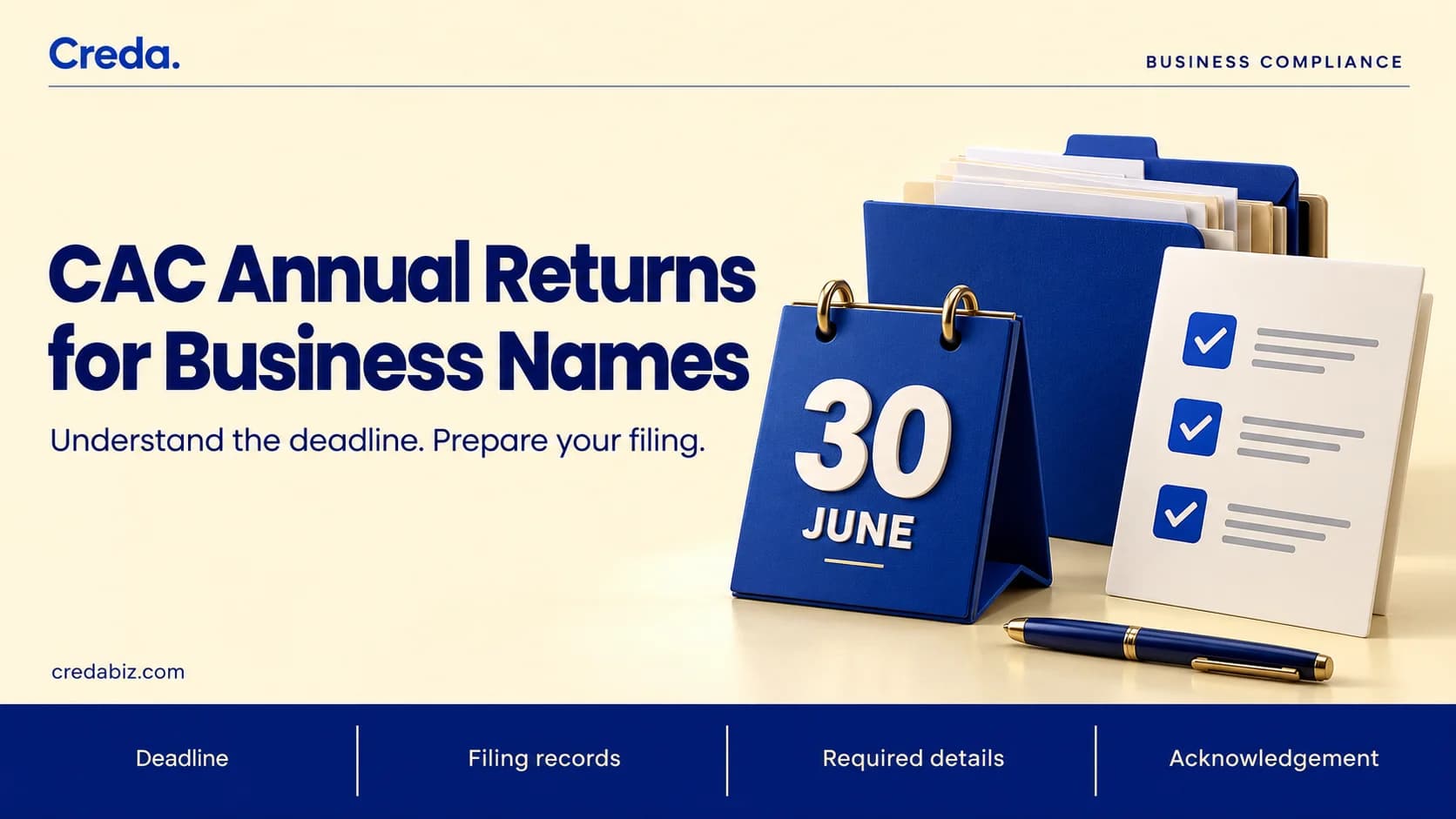
But a registered business name has an ongoing CAC filing obligation. Section 822 of CAMA 2020 sets a deadline of 30 June each year, with an exception for the calendar year in which the business name was registered. The return includes business particulars and is accompanied by a financial statement for the previous calendar year.
This guide concerns business names. Companies, partnerships registered under other statutory structures, and incorporated trustees have their own rules; do not transfer a deadline from one entity type to another.
What are CAC annual returns for a business name?
An annual return supplies the Corporate Affairs Commission with the prescribed information about the registered business and the people behind it.
It is a separate obligation from a tax return. Filing with CAC does not, by itself, complete filings with a tax authority. Equally, paying tax does not stand in for a CAC annual return.
It helps to keep two separate headings in your records: “CAC filings” and “tax filings." Store the evidence under the correct heading so a payment receipt for one is not mistaken for proof of the other.
When is the annual return due?
For a registered business name, section 822 provides for filing by 30 June, excluding the calendar year of registration.
For illustration, a business name registered in October 2026 falls within that registration-year exception for 2026. Under the statutory rule, its next annual filing deadline is 30 June 2027. Confirm the correct return period and the current submission route for the particular record before filing.
Do not automatically apply an “18 months after registration” rule to a business name. Start with the rule for your actual entity type.
Also distinguish the legal obligation from the portal's functionality. A missing filing option is a reason to seek guidance, not evidence that the obligation has disappeared.
What information should you gather?
CAC's published business-name annual return form, CAC/BN 06, provides a useful preparation guide. Have these records available:
The registered business name and registration number.
The nature of the business.
The principal business address and any branch details.
The relevant return and accounting periods.
The financial information requested for that period.
The proprietor or partners' particulars.
The accompanying financial statement and required authorization.
The published form expressly distinguishes an annual return from a notice changing proprietor or partner particulars. If the underlying registration record needs changing, identify the appropriate additional filing rather than expecting the annual return to do everything.
Before submitting, read the figures alongside your records. A convenient estimate is not a substitute for information you can support.
How to approach the filing
1. Establish what has already been filed.
Locate previous acknowledgements and check which periods they cover. If someone filed on your behalf, ask for the actual filing evidence, not just confirmation that money was paid.
Make a short list of the periods that need attention. That list should guide the work and the quotation.
2. Confirm the current CAC process
Use CAC's official portal and current guidance. When researched on 28 October 2026, the iCRP homepage carried a notice about annual-return availability for business names registered before July 2025 and a planned wider automated process.
That notice describes a changing portal service. It is not a general exemption for newer registrations. Check the current position for your record before paying or following an old tutorial.
3. Prepare and review the return.
Check the business particulars, period, figures, and supporting statement together. Resolve discrepancies before submission and retain the version actually filed.
4. Check the charges before payment.
Ask for the current statutory filing charge, any applicable late charges, and any separately agreed professional service fee. These are different items and should be explained separately.
For Creda's support, confirm the current service price on the relevant Creda service page and obtain a scope-specific quotation where needed. The periods outstanding and circumstances of the record need checking before the work is priced.
5. Keep the acknowledgement.
Save the submitted documents, payment evidence, and filing acknowledgement in a folder labelled with the relevant period. Check whether further action or a query remains outstanding.
A payment receipt and a completed filing are different stages. Keep evidence of both.
What if you missed previous annual returns?
Start by establishing the gaps. Section 822 provides for penalties for non-compliance, but the amount payable should be confirmed against the applicable regulations and your filing position.
Avoid making a second registration simply because the first record has become difficult to manage. First find out what is outstanding on the existing record and what is required to regularize it.
If the business has stopped operating, ask about the appropriate cessation process. Do not assume that having no sales automatically settles every outstanding obligation.
A practical calendar you can maintain
Put an internal reminder well before the statutory deadline. For example, reserve time in April to check the record and gather documents, then a second reminder to confirm submission and retain the acknowledgement.
Record three things against each task: who is handling it, what remains outstanding, and where the evidence will be saved. This makes follow-up much easier when a staff member or service provider changes.
Annual returns are one part of the wider post-registration checklist, alongside tax, records and any sector-specific obligations.
Frequently asked questions
Are CAC annual returns the same as renewing my business name?
Annual returns are a recurring filing obligation. Calling them a “renewal” can obscure what is actually being submitted. Ask for the filing type, period, and acknowledgement.
Must a newly registered business name file in its registration year?
Section 822 excludes the calendar year in which the business name was registered. Confirm the next applicable period and current process for the record.
Can the annual return change the proprietor's details?
CAC's published annual return form says it is not the form for notifying changes in proprietor or partner particulars. Check the appropriate change filing separately.
Can I use this deadline for my limited company?
No. This guide addresses business names. Have the company's obligations assessed under the provisions that apply to its own structure.
Get a clear picture of what is outstanding.
If you have fallen behind, you do not need a lecture. You need to know which periods need filing, what documents are missing, and what the work will cost.
Ask Creda to review your CAC compliance position and help you plan the required filings.
Sources
Information researched on 28 October 2026. Confirm current portal arrangements and charges before filing.
Join the conversation
Share a brief thought or question about this article.
No comments yet. Be the first to share a thought.
Suggested for you
Annual returns and CAC filings
Do I Need to Update CAC When a Director Leaves?
When a company director leaves, record the decision, update internal registers and notify CAC through the applicable filing. CAMA sets a 14-day notice period for a person ceasing to be a director.
8 November 2026

Annual returns and CAC filings
What Is the Difference Between CAC Annual Returns and Tax Returns?
These filings serve different authorities and purposes. A CAC annual return updates the corporate register; a tax return deals with tax reporting. Completing one does not prove the other has been completed, and a payment receipt is not always evidence that a filing was accepted.
5 November 2026

Annual returns and CAC filings
How Do I Update My Business Address After Moving?
A move can require updates across several records. The CAC record, tax profile, bank account and customer-facing contact details serve different purposes. A change on one system should not be assumed to flow automatically into all the others.
1 November 2026