
Business growth and strategy
What Can You Export from Nigeria? Major Commodities and Product Selection
Explore Nigeria’s major agricultural exports, compare product risks and learn how to choose an export commodity using demand, quality, capital and compliance.
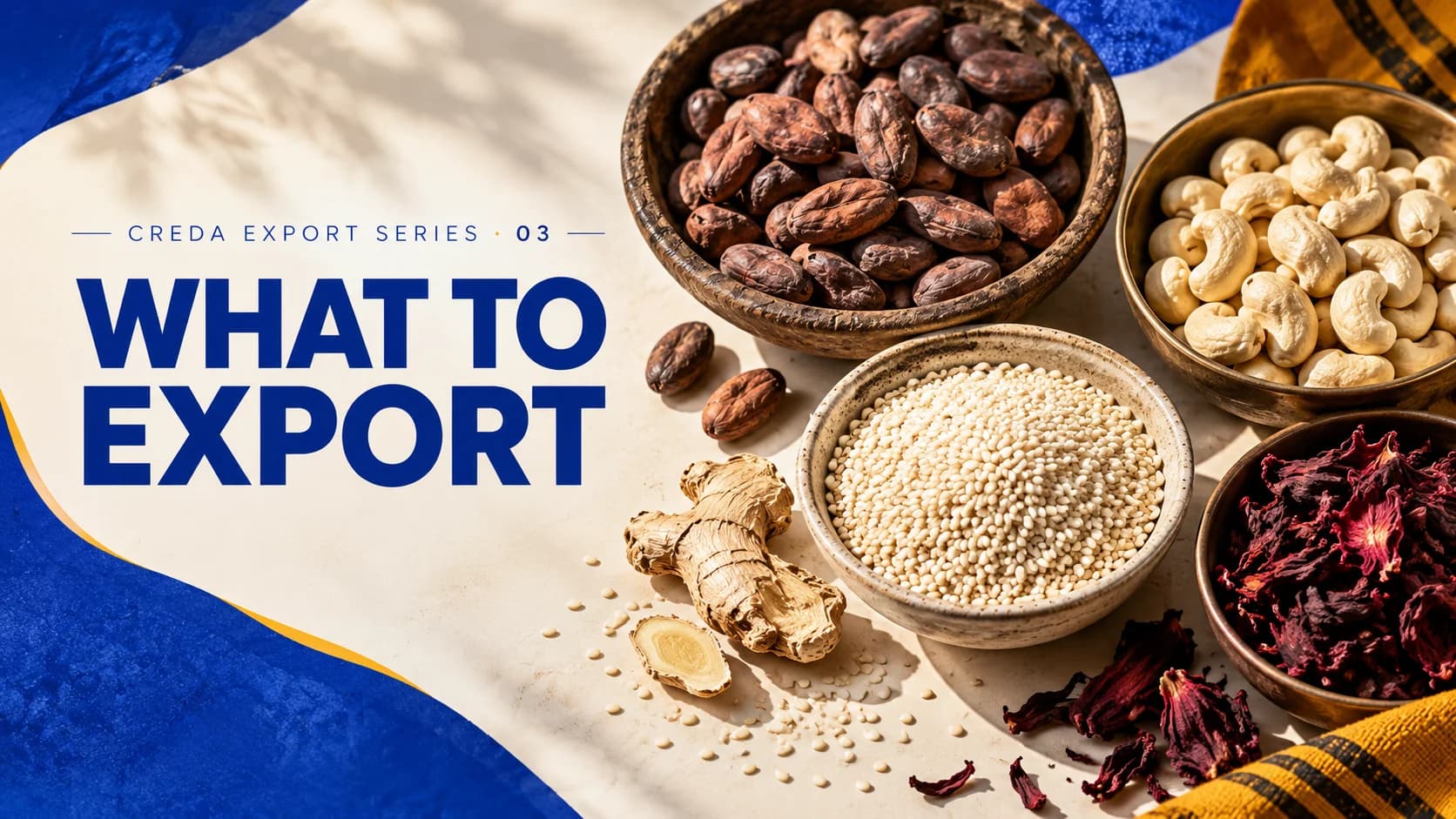
CredaBiz Export Series · Part 3 of 6. Sources checked 30 October 2026. Requirements depend on your product, destination and shipment.
The product with the highest national export value is not automatically the best product for your business. A large market may be served by established exporters with processing capacity, financing and supply relationships that a newcomer cannot immediately reproduce.
Choose a product you can understand, source consistently, prepare to specification and sell at a defensible margin. Start by separating national trade performance from your own commercial readiness.
What are Nigeria’s biggest exports?
The NBS Q2 2026 report lists crude oil, kerosene-type jet fuel, natural gas, urea and other petroleum gases among the leading export commodities. That is the national trade picture, not a beginner’s shopping list.
For agricultural exports, the same report provides a more relevant starting point:
| Agricultural product | Q2 2026 export value, rounded |
|---|---|
| Cashew nuts in shell | ₦268.62 billion |
| Standard-quality cocoa beans | ₦154.31 billion |
| Sesame seeds | ₦96.03 billion |
| Superior-quality cocoa beans | ₦58.82 billion |
| Soya beans, excluding seed category | ₦50.22 billion |
| Soya-bean flours and meals | ₦36.41 billion |
| Natural cocoa butter | ₦27.60 billion |
These are selected agricultural categories, not a complete ranking of all Nigerian exports. Cocoa bean grades are separate report entries; they should not be silently combined and then presented as the original table. Export value also says nothing about an individual exporter’s profit.
Source: NBS Q2 2026 report and tables, released 7 September 2026, especially report pages 4 and 21–22. The report and spreadsheet were examined directly for this article.
A commercial shortlist, not a promise of profitability
| Product family | What to investigate before committing stock |
|---|---|
| Cocoa beans and processed cocoa | Grade, fermentation, moisture, contamination controls, origin records and buyer traceability requirements |
| Cashew | Whether the buyer wants raw nuts or kernels; grading, condition, processing losses and seasonal procurement |
| Sesame | Cleaning, foreign matter, microbiological safety, residue tests and batch traceability |
| Ginger | Fresh, dried, split or powdered form; drying method, hygiene, contaminants and reliable seasonal supply |
| Hibiscus | Botanical identity, cleanliness, drying, colour consistency and the intended food or ingredient use |
| Soy and soy derivatives | Exact product specification, intended use, processing capability and destination conditions |
| Shea butter or oil | Food versus cosmetic use, product specification, processing quality and packaging compatibility |
| Packaged foods | Shelf-life evidence, ingredients, labels, importer arrangements and destination food rules |
This table is a set of due-diligence questions. It does not certify that every listed product is currently admissible in every destination.
For example, CBI’s sesame market-entry research highlights microbiological and chemical contamination risks. Its dried-ginger guidance similarly emphasises hygiene, contaminants, residues and traceability. Ask buyers and competent laboratories which current tests and limits apply to your consignment; do not copy an old numerical limit from a general article.
Check restrictions before treating a product as an opportunity
Raw shea nuts require particular care. A State House announcement dated 26 February 2026 extended the raw-shea-nut export ban through 25 February 2027, withdrew direct-export waivers and described an NCX framework for excess supply. It is not a general invitation to export raw nuts freely.
Processed shea butter is a different product, but that distinction does not remove its own standards and destination requirements. Obtain current confirmation of the applicable route.
More broadly, do not rely on an old list of “hot export products.” The 2026 fiscal-policy announcement includes a revised export prohibition list. Check the exact classification and current controlling instrument with Customs before sourcing potentially controlled goods, including timber, wildlife-related goods, hides or scrap. A product appearing in historical trade data is not proof that today’s proposed shipment is permitted.
Score products against your real capabilities
Use this editorial scorecard. Give each factor 1–5, where 5 means strong, documented readiness. Multiply by the weight and divide by five.
| Factor | Weight | Evidence for a high score |
|---|---|---|
| Demonstrated buyer demand | 25 | Specific enquiries, buyer interviews and workable specifications |
| Reliable supply | 20 | Inspected suppliers, repeatable quality and backup capacity |
| Compliance feasibility | 20 | Clear permissions, testing route and importer acceptance |
| Working-capital fit | 15 | A funding plan that covers the complete cash cycle |
| Logistics and shelf life | 10 | A suitable route and adequate usable life at delivery |
| Your knowledge and relationships | 10 | Practical sector knowledge and verifiable partners |
A high total does not override a legal restriction, failed test or absent buyer. Treat any of those as a stop condition, not a minor scoring penalty.
Compare raw commodities with value-added goods
Processing may create a more differentiated offer, but it also adds responsibilities. Turning raw produce into powder, butter or a packaged retail product changes equipment, hygiene controls, labelling, shelf-life work and buyer expectations.
Ask whether the extra price exceeds the extra costs and losses. A smaller branded pack may sell at a higher price per kilogram while costing more to market, distribute and keep compliant. Bulk sales can be simpler commercially but demand consistency and scale.
Validate the sample and the batch
An impressive sample is useful only if it represents the goods you will ship. Record where it came from, who selected it and the batch it represents. Agree what happens if the shipment differs from the approved specification.
Visit the supply chain where practical. Understand storage, handling, cleaning and any treatment. Keep a retained sample and batch records where appropriate. These habits make a quality dispute easier to investigate.
Frequently asked questions
Which Nigerian commodity is most profitable to export?
There is no reliable universal answer. Your purchase price, usable yield, testing, freight, finance, buyer price and losses determine profitability.
Can I start with a small budget?
Possibly, but choose a model and order size that fit your available cash. Do not borrow for a large batch before establishing demand and the full compliance cost.
Should I choose a product because it is popular online?
Use online interest as a lead for research. Validate an actual buyer, specification, cost and route before purchasing stock.
Turn a product idea into an operating plan
CredaBiz’s Business Support & Advisory can help organise the business model, documentation and planning questions. Technical product testing and official commodity approvals should be handled by the appropriate specialists.
Read next: Part 4, Where to Export Nigerian Products: Markets, Buyers and Entry Requirements.
Start with Part 1: How to Start Exporting from Nigeria.
Join the conversation
Share a brief thought or question about this article.
No comments yet. Be the first to share a thought.
Suggested for you

Business growth and strategy
How Can I Separate Business Money From Personal Spending?
Use a consistent system for business receipts, expenses and owner transactions. A dedicated account helps, but the records must still explain withdrawals and transfers. Start with accurate categorisation rather than trying to make the statements look artificially busy.
8 November 2026

Business growth and strategy
What Should My Business Website Include to Convert Enquiries?
A business website should answer who the service is for, what it includes, what happens next and how to enquire. Make forms mobile-friendly, confirm the response route and measure completed enquiries.
6 November 2026

Business growth and strategy
Export Pricing and Payments: Protecting Your First International Sale
Calculate export costs, understand delivery terms, compare payment risks and prepare a safer first international sale from Nigeria.
4 November 2026